
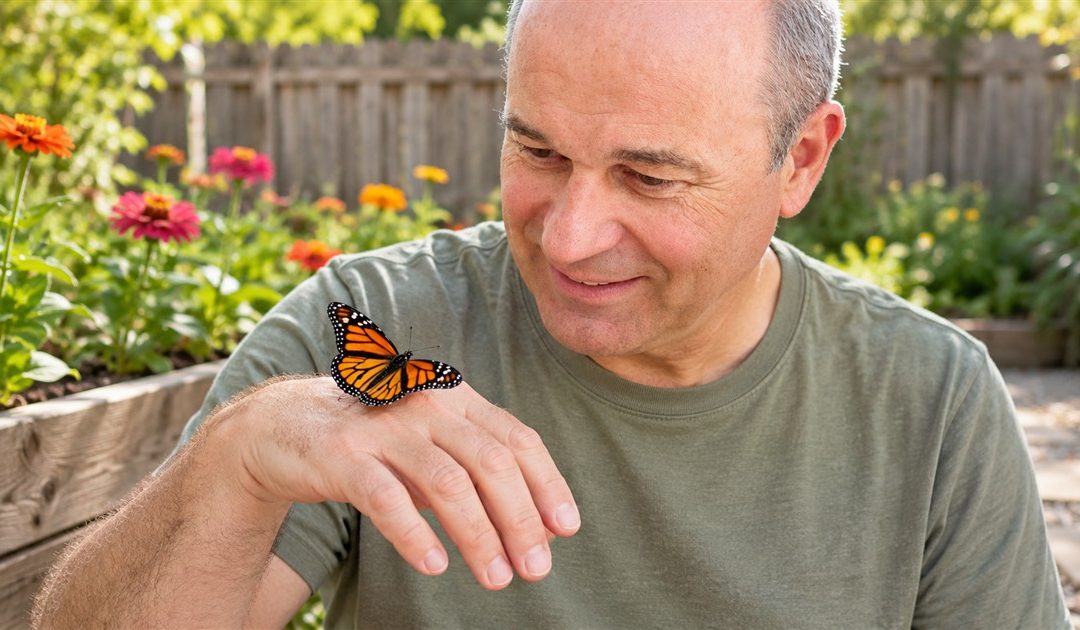
A butterfly pauses near you, rests on your hand or appears just as you are thinking about someone you miss. For a person who welcomes spiritual signs, a small encounter can feel surprisingly intimate. You may connect it with change, encouragement or a moment of remembrance.
Begin with the association that arose naturally. What was happening in your life? What did the encounter bring to mind? You can value its meaning without needing to prove that the butterfly arrived with a particular message.
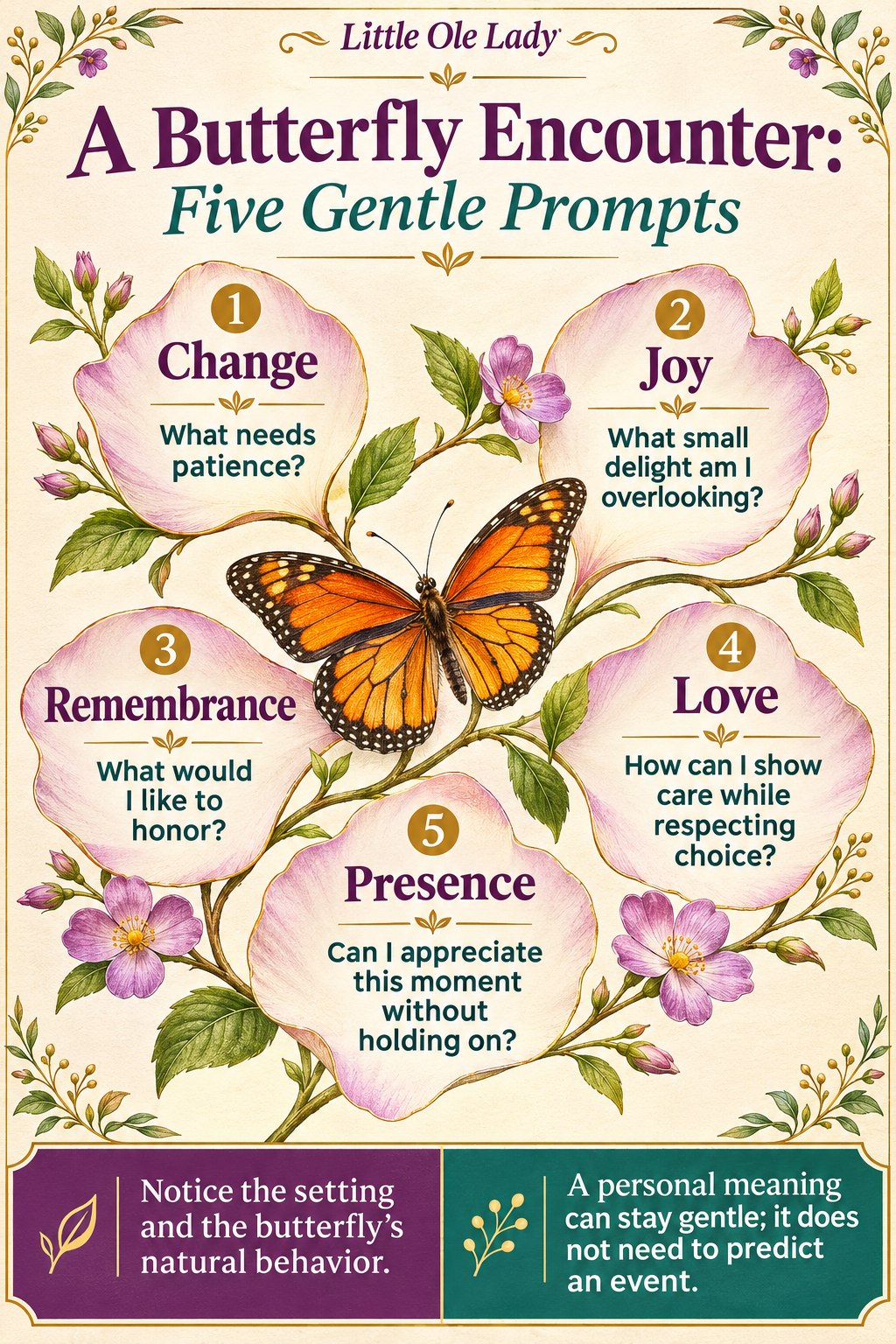
Five meanings you might explore
1. Change that takes time
The butterfly’s transformation makes it a familiar image of a new chapter. If you are between roles, relationships or ways of seeing yourself, ask what is changing gradually rather than demanding an instant reinvention.
Reflection: what part of this transition needs patience?
2. Joy in an ordinary moment
Color, movement and a brief pause outdoors may remind you to notice pleasure without earning it first. A spiritual response can be as simple as making room for something beautiful today.
Reflection: what small delight have I been overlooking?
3. Remembrance and connection
Some people associate butterflies with a loved one who has died. A memory may feel comforting, especially around an anniversary. The encounter does not establish who or what caused it, but the love it brings to mind can still matter.
Reflection: what would I like to remember or honor?
4. Love with room to breathe
You might connect the butterfly with affection, tenderness or freedom. Let that lead to a caring action rather than a prediction about who will fall in love or what someone secretly feels.
Reflection: how can I show care while respecting another person’s choice?
5. Being present without holding on
A butterfly rarely stays on command. Its brief visit can invite you to appreciate an experience without trying to possess it. That may speak to a relationship, a season of life or the wish to make a happy moment last forever.
If you are navigating a wider change, our guide to moving along your spiritual journey offers another place to begin. You can explore a symbol without deciding that your whole future has been revealed.

Does landing on you have a special meaning?
A butterfly resting on your hand or shoulder can feel like an invitation to pause. There is no dependable spiritual code in which a landing on the head predicts success, a landing on the stomach predicts pregnancy or a landing on the finger guarantees romance. Treat those interpretations as stories people may tell, rather than information about your body or future.
Butterflies also have their own needs. The American Museum of Natural History explains puddling, a behavior through which butterflies obtain dissolved minerals and salts. A review of butterfly puddling research includes sweat among the fluids some butterflies visit. An ordinary explanation and a meaningful personal association can coexist.
Stay still if that is comfortable, give the butterfly room to leave and avoid touching or gripping its wings. You do not need to catch it, prolong the contact or arrange a second encounter to make the first one count.
Color is a prompt, not a prediction
A white butterfly may remind you of peace; yellow may suggest cheerfulness; orange may bring warmth or confidence to mind. Someone else may make a different association because of their memories, culture or the species common where they live.
Ask “What does this color mean to me today?” before consulting a fixed color chart. A dark butterfly is not evidence of bad luck, and a bright one does not guarantee good news. You do not have to fear an insect because an online list assigns its color an ominous meaning.
Cultural meanings deserve their own context
Butterflies do not mean the same thing in every tradition. For one specific example, the Metropolitan Museum of Art’s description of a Chinese jade butterfly connects the motif with weddings, joy and longevity. That is a useful cultural example, rather than a universal definition of every butterfly encounter.
If a religious or family tradition matters to you, explore its own stories and language. Avoid combining distinct beliefs into a single claim about what everyone has always believed.
Free butterfly-encounter reflection log
Copy these six headings into a private phone note. A few words under each is enough.
- What happened? Describe the place, movement and landing, if any.
- What was the context? Note the weather, surroundings and what was already on your mind.
- What did I feel? Name the feeling before interpreting it.
- What association arose? Change, remembrance, joy or something else?
- What else could explain it? Leave space for natural behavior and coincidence.
- What small action fits? Contact someone, enjoy a walk, tend a plant or allow a transition more time.
Example: “A butterfly rested nearby while I was thinking about a new job. I felt hopeful. I connected it with change; the garden also had flowers attracting insects. I will prepare one question for my first week.”
When a butterfly appears in a dream
Start with the dream’s feeling and story. Were you watching, chasing, protecting or letting it go? A butterfly in a dream may offer a way to think about change or freedom, but it does not establish that an event has occurred elsewhere or must happen next.
Our article on understanding intuition can help you give an impression attention while still considering context. You can keep a dream meaningful without turning it into an instruction.
Frequently asked questions
1. What does a butterfly mean spiritually?
Common personal associations include transformation, joy, remembrance, affection and freedom. The meaning depends on your context rather than a single universal code.
2. Is a butterfly a sign from a deceased loved one?
Some people understand it that way and find comfort in the association. The encounter does not establish its cause or identify a presence.
3. What if a butterfly lands on my hand?
You may use the moment to pause and reflect. Natural behavior, including interest in salts and moisture, may also help explain the landing.
4. Does where it lands predict an event?
A landing on a particular body part does not reliably predict pregnancy, romance, success or another future event.
5. Does a white butterfly always mean peace?
Peace is one possible personal association. Color meanings vary with culture, memory and the butterflies common in your area.
6. Is a black butterfly bad luck?
A dark butterfly does not establish that something bad will happen. You do not need to fear it because of a color interpretation.
7. What might an orange butterfly symbolize?
You might associate orange with warmth, energy or change. Treat that as a reflection prompt rather than a forecast.
8. Can a butterfly encounter symbolize love?
Yes, it may remind you of affection or tenderness. It does not establish another person’s feelings or guarantee a relationship.
9. Do all cultures share the same butterfly symbolism?
No. Meanings belong to particular cultural, religious and personal contexts. Explore the tradition involved rather than assuming one shared definition.
10. What does a butterfly in a dream mean?
Consider the dream’s emotion and what you were doing with the butterfly. Change, freedom and letting go are possible themes, not fixed answers.
11. Why might a butterfly be attracted to a person?
Some butterflies visit salt-rich fluids such as sweat. The surroundings and the insect’s behavior are useful context alongside your personal association.
12. Should I hold a butterfly to keep it near me?
Give it room to leave and avoid gripping or touching its wings. You do not need to prolong the encounter for it to feel meaningful.
13. What should I record in the free log?
Describe the encounter, context, feeling, association, another possible explanation and one small action you might choose.
14. What if I never see another butterfly?
A lack of further encounters does not mean you have lost love, support or permission to move forward.
15. What is a useful response to a meaningful encounter?
Choose a small action connected with the association, such as honoring a memory, expressing care or giving a transition more patience.