

When a new relationship brings up uncertainty, separate what happened from what you think it means. A feeling deserves attention, but its calmness or intensity cannot establish another person’s intentions.
Ask a direct question when appropriate, state your boundaries and choose a pace that lets you observe behaviour. You can continue, slow down or step away without proving whether an impression was intuition or fear.
Observation, interpretation and a useful response
| Observation | Possible added story | Practical response |
|---|---|---|
| One message has not been answered | They have lost interest | Consider context and discuss contact preferences |
| They keep asking after you decline | Maybe I am overreacting | Recognise the pressure and protect your boundary |
| Your relationship goals are unclear | We must be destined for each other | Ask what each person actually wants |
| You check every message repeatedly | One more clue will remove uncertainty | Pause and choose one question that matters |
Scroll sideways to see the full table.
Name the Experience
Talk about what you notice before you decide what that means. If you notice that your chest feels tight after a conversation, this is an observation about what you experience. If you say, “This person is going to betray me,” this is a prediction that doesn’t have facts behind it.
You might feel excited, tense, warm, hesitant, or have a desire to get out of the relationship. There are many feelings that can come up together, and mixed reactions don’t mean that you’re not listening to your intuition.
Allow yourself to feel the sensation in the situation. You might take time to pause and finish your regular routine, then go back to the question later. The purpose of this isn’t to hide your feelings, but to help you avoid making a decision based on your first interpretation.
Of course, immediate danger is a different situation altogether. Always put your safety first instead of trying to analyze the feeling. You don’t have to let fear be your intuition before taking protective action for your life.
Promise Vs. Inner Signals
Advice can talk about intuition as quiet, clear, and certain, and fears are often seen as noisy and repetitive. These are descriptions that fit personal experiences, but they shouldn’t be used as a diagnostic rule.
A person can feel at peace because they overlooked information, but they can feel afraid because they paid attention to their own boundary violations. They can also be afraid in situations that are respectful because closeness is something unfamiliar, or because the closeness reminds them of an experience in their past.
The question isn’t just about what feeling is there, but you need to ask what happened, what you’re assuming, and what kind of response would work for you, even if your first explanation is incomplete.
You don’t have to be confident before you decide how to move forward. Dating means learning about another person slowly. Having a lot of uncertainty can still remain while you’re careful with the choices you make.
Check a New-Relationship Feeling: visual guide
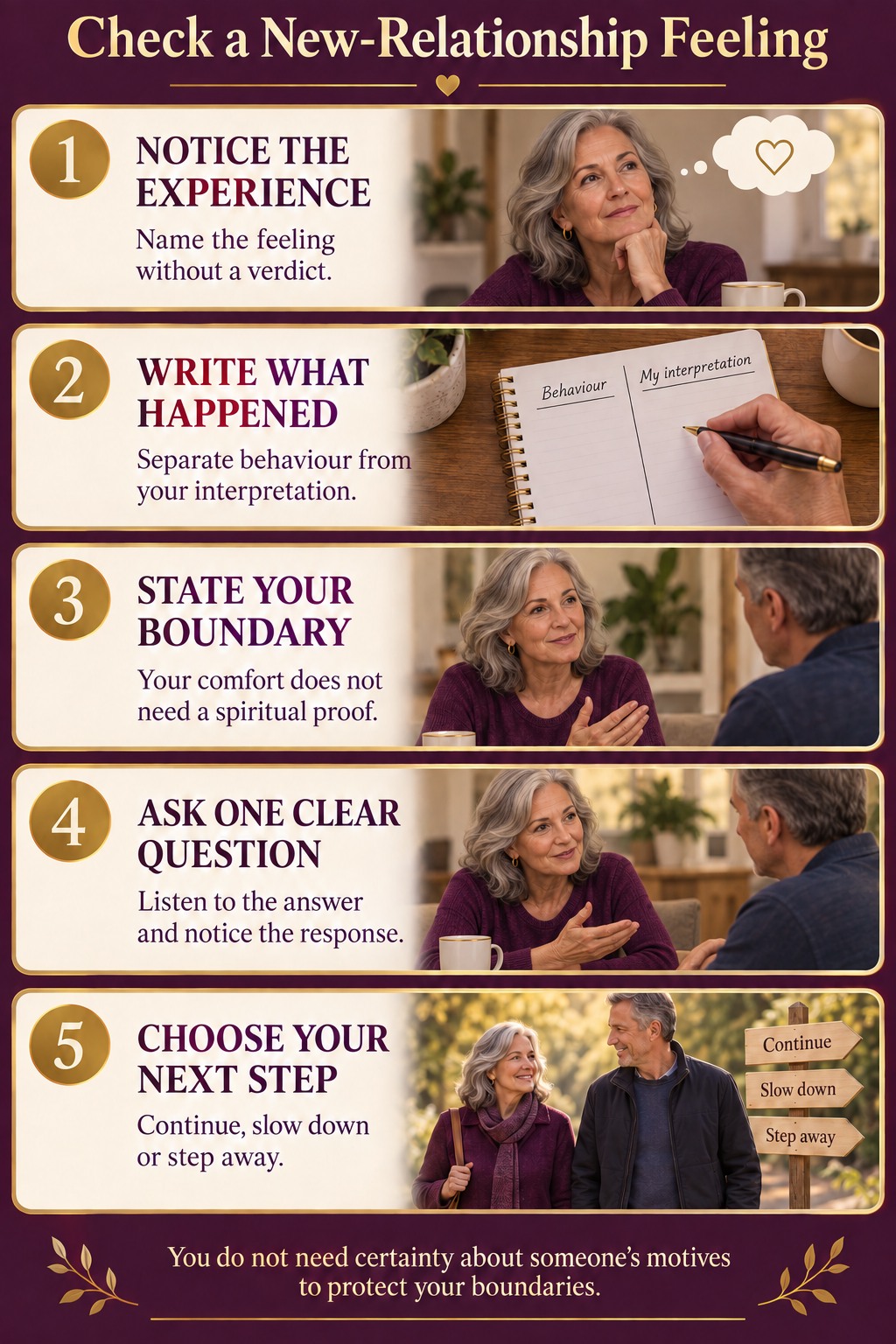
Read the infographic as text
- 1. NOTICE THE EXPERIENCE: Name the feeling without a verdict.
- 2. WRITE WHAT HAPPENED: Separate behaviour from your interpretation.
- 3. STATE YOUR BOUNDARY: Your comfort does not need a spiritual proof.
- 4. ASK ONE CLEAR QUESTION: Listen to the answer and notice the response.
- 5. CHOOSE YOUR NEXT STEP: Continue, slow down or step away.
Observations from Stories
Write down one example, such as “They didn’t reply to the message I left them yesterday” or “They kept asking after I already said no.” These are different situations that require different responses, even if both cause anxiety.
Figure out the story you’re adding. A missed reply could mean they lost interest or that they’re testing you, but repeated pressure after saying no already indicates an observable boundary issue, even if the motives are unknown.
Ask what information there is. Has the person explained their communication habits, or was there even an agreed plan? Did they respect your limits earlier? Always focus on patterns you can observe instead of looking for hidden certainty.
Doing this helps you not treat every uncomfortable moment as informative. It also helps prevent the opposite: dismissing behavior just because you thought you were feeling anxious for no reason.
Responding to Boundaries
You can set a boundary before you know why you feel uneasy about something. You might want to meet in public, have a slow pace, or take more time before you become intimate. These are preferences that don’t need an explanation.
The boundaries guidance from Love Is Respect emphasizes that personal limits are part of a healthy relationship. A respectful person can hear your preference without demanding that you prove your feelings are reasonable.
Pay attention to whether they accept your boundary, ask respectful and clarifying questions, or keep trying to wear you down. This response can give you information about the interaction that private intuition can’t.
Don’t create a deceptive test or try to provoke jealousy just to see what’s going to happen. Use your preferences and have regular conversations. A boundary is a statement about how you participate, not a trap designed to expose someone.
Pay Attention to History
Previous experiences can influence what feels threatening, familiar, or comforting to you. Notice the influence and let it be helpful to you, but don’t let it be a reason to ignore every concern that you have now.
You might notice that a delayed reply reminds you of a former partner and how they disappeared. This kind of association helps explain your reaction, but it doesn’t prove that the new person is going to act the same way, and it doesn’t prove that they’re different.
Ask what belongs in the current situation. Was this person doing what they agreed to? How have they behaved in the past? What do you need to feel able to continue at a comfortable pace?
If the past is hard to separate from the present, getting support can help. You don’t have to solve your entire relationship history before dating, but you also don’t have to manage repeated distress on your own.
Reassurance: A Loop or Help?
It’s normal to want reassurance when you make a new connection. The question is whether an answer can help you understand your situation or whether the relief only comes for a short period before the same questions show back up.
Repeatedly checking your messages, asking people to interpret every phrase, or getting a lot of psychic readings about the same person can draw more attention to the uncertainty. More input doesn’t always create more clarity.
Try picking one question that can be answered, such as “What kind of relationship does the person want?” Ask this directly when you can and then consider their response along with their behavior instead of asking the same question through different symbolic systems.
If checking feels hard to control or interferes with your day, take a break from checking and get support when necessary. The purpose is to help you live with uncertainty, not to find unlimited sources of certainty about another person.
Reframing Assumptions
The NHS guide to reframing unhelpful thoughts suggests examining evidence and considering a more balanced perspective. In dating, that can mean changing “A short reply proves rejection” to “I do not know what this reply means without more context.”
Having a balanced statement doesn’t mean that you have to trust the person totally. It just means that you avoid claims where there’s not enough information. You can still decide if their communication style works best for you.
Reframing shouldn’t excuse harmful behavior, of course. If someone threatens you, ignores your refusal, or humiliates you repeatedly, then the issue isn’t about finding a positive interpretation, focus on the observable behaviour and your safety.
Accuracy is the goal. Sometimes having a balanced view is reassuring, but sometimes it confirms what needs your attention. You’re allowed to come to either conclusion with evidence in front of you.
Take Your Time When You’re Not Sure Yet
You don’t have to decide right away if a new relationship is going somewhere serious. Sometimes slowing things down gives you more time to get to know the person and see how the relationship actually feels before making bigger commitments.
This might mean meeting in public for the first few dates, keeping up with your normal routines, waiting before mixing finances, or talking about what you both want before becoming exclusive. There isn’t one timeline that works for every relationship. What matters is moving at a pace that feels comfortable for both of you instead of thinking you have to follow someone else’s idea of when certain things should happen.
You can also be honest about it. You might say, “I really like getting to know you, but I want to take things slowly.” The other person can then decide if that pace works for them too. If one person wants to move much faster than the other, that might show a difference in what each person wants without automatically making either person wrong.
Taking things slowly also shouldn’t be used as a game to make someone chase you or become more interested. The point is to give yourself enough time to see what’s actually happening. As time goes on, you can pay attention to their actions, how consistent they are, and how the two of you handle different situations before deciding what you want next.
An Example with an Unanswered Message
After a good date, Melissa sends Ryan a message and doesn’t hear anything back that evening. At first, she starts wondering if something has changed or if the date didn’t mean as much to him as she thought it did.
Instead of immediately deciding that his silence means something bad, Melissa reminds herself that they never talked about how quickly either of them normally responds to messages. Ryan had also mentioned that he had a busy couple of days coming up at work. She gives it some time and goes on with her evening instead of checking her phone every few minutes.
When Ryan does reply, Melissa has a little more information about how he normally communicates. She can decide if his communication style works for her as she gets to know him better. If slow replies or unclear communication keep happening and leave her unhappy, that might eventually show that their communication styles aren’t a good match. She doesn’t have to assume that Ryan had bad intentions to recognize that something isn’t working for her.
Of course, this doesn’t mean that every unanswered message should be ignored or explained away. It just means that one unanswered message usually doesn’t give you enough information to know the whole story. Sometimes giving a situation a little more time lets you see a pattern instead of making a decision based on one uncertain experience.
Example of Refusal
If Monica says she doesn’t want her date to come to her home yet, and the person keeps asking her and making jokes about it, and suggests that trust requires her to change her mind, that is pressure rather than respect.
Monica might feel anxious and wonder if past experiences are making her overreact. She doesn’t have to settle the question before she recognizes that her boundaries are being challenged.
She can choose to end the conversation, decline another date, or get support if the pressure continues. Her response can be based on the behavior she observed instead of a claim about knowing the person’s future intentions.
This is why feelings and facts need to be considered together. Knowing that you can feel anxious shouldn’t be an instruction to ignore a clear refusal or disrespect.
Spiritual Interpretations
A dream, a symbol, a tarot card, or a sense of recognition might feel meaningful when you meet somebody new. You can look at the feelings it brings up without thinking that this proves a shared destiny.
Ask if the interpretation leaves both people free to choose. Believing in someone as a soulmate shouldn’t mean that you overlook their wishes, rush into intimacy, or accept treatment that you wouldn’t otherwise.
If you get a psychic reading, keep the questions focused on your own feelings, such as, “What am I hoping to get out of this connection?” This is different than asking a psychic to tell you if the other person is trustworthy or not.
No spiritual label can mean consent or compatibility. Let the experience be part of your inner life, and the relationship should develop through conversations, agreements, and behavior that both people see.
Fear and Support
If you’re constantly worrying, this can be a problem no matter if the relationship continues or not. The NIMH guide to generalized anxiety disorder describes anxiety that is difficult to control and interferes with daily life. A professional can help assess ongoing distress without requiring you to dismiss your beliefs.
Getting support can also help you become clearer about what you actually want from the relationship. Sometimes when you’re caught up in trying to understand another person, it’s easy to lose track of your own needs. Talking things through might help you figure out what you’re comfortable with, what your boundaries are, and what you need to communicate directly.
The point isn’t to convince yourself to stay in a relationship that constantly makes you uncomfortable. It’s to help you respond in a way that protects your well-being instead of letting worry make every decision for you. You can still decide that a relationship isn’t right for you, even if you can’t prove that the other person did something wrong.
If someone is threatening you, pressuring you, controlling you, or making you feel that you’re in immediate danger, treat that as a safety issue. You don’t need to figure out the psychological or spiritual meaning behind their behavior first. Getting yourself somewhere safe and reaching out for appropriate help comes before trying to understand why the person is acting that way.
Pick One Thing You Want to Know Next
When everything starts feeling tangled together, try narrowing it down to one question that would actually help you decide what to do next. Maybe you want to know what the person is looking for, if they’re emotionally available, or if they’re comfortable with a boundary that matters to you. When it feels appropriate and safe, asking directly can usually tell you more than collecting a bunch of little clues and trying to connect them.
For example, wondering if someone wants a committed relationship is very different from wondering why they said “hey” instead of “good morning” yesterday. If you want to know what kind of relationship they’re looking for, asking about their intentions gives you useful information. Analyzing one short greeting could give you ten different possibilities without actually answering the question you care about.
Their answer doesn’t have to tell you everything about the future. It might simply give you enough information to decide if you want to keep getting to know them at the same pace, slow things down, or step away.
You also don’t have to solve every uncertainty before making a decision. Some things only become clear as time goes on. You can leave a few questions unanswered while still being clear about what you need, what you’re comfortable with, and what you won’t accept in a relationship.
Final Thoughts: Making a Choice That Fits Your Life
You might decide to continue the relationship, slow down, ask a question, or end the connection completely. You don’t have to have absolute certainty about the other person’s feelings or character to decide how you choose to participate. A relationship can be unsuitable for you without being dangerous.
Keep a note on what informed your decision, if that helps. If you watch the behavior, express your preferences, and pay attention to the responses you receive, write this down. Don’t turn your note into an investigation of every interaction you have with them.
As you get more information, you can update your thoughts. Changing your mind doesn’t mean that your intuition failed, but it can be a sign that you’re responding to a bigger picture.
You may not be able to label every impression as intuition or fear. Notice the feeling, check behaviour and let consent, your values and the available information guide the next step.
For examples of encouraging behaviour, read dating after 50 green flags.
For the next step, explore beginning a relationship after 50.
Frequently asked questions
1. Can I distinguish intuition from fear by how it feels?
There is no dependable calm-versus-anxious test. Name the concern and look at the observations, assumptions and available information.
2. Does calmness prove I should trust someone?
No. A calm impression can overlook important information. Trust develops through behaviour, communication and the agreements you make.
3. Does anxiety mean the relationship is wrong?
Not automatically. Anxiety can arise for different reasons. It also does not cancel an actual boundary violation.
4. What is the difference between an observation and a story?
An observation describes what happened, such as an unanswered message. A story adds a meaning, such as assuming rejection, which may remain unconfirmed.
5. Does a delayed reply prove disinterest?
No single delay establishes the reason. Consider context, contact preferences and patterns while deciding whether the communication style suits you.
6. What if someone keeps asking after I say no?
Repeated pressure is observable behaviour. You do not need to label the feeling intuition before protecting your boundary or declining further contact.
7. Can I choose public meetings without explaining my history?
Yes. You can state the setting you prefer without disclosing private experiences. The other person can choose whether that arrangement suits them.
8. How can past experiences affect a new connection?
They can shape associations and reactions. Notice the link while assessing what this person actually says and does; similarity is not proof of an identical outcome.
9. What is a useful direct question?
Ask something that affects your choice, such as what kind of relationship they want or which contact pace works for them. Avoid interrogating every small phrase.
10. How do I avoid testing the person secretly?
Express a real preference or question. Provoking jealousy or creating a trap gives less useful information than ordinary honest interaction.
11. What if reassurance helps only briefly?
Notice whether repeated checking adds information or simply restarts the same uncertainty. Pause and choose one practical enquiry or appropriate support.
12. Can a soulmate feeling establish mutual consent?
No. A meaningful private interpretation does not establish the other person’s wishes. Their stated choices still matter.
13. Do I need evidence of wrongdoing to end a connection?
No. You can decide that the relationship is unsuitable or that you do not want to continue without proving a hidden motive.
14. When should I seek support for persistent worry?
Consider qualified support if worry interferes with daily life or feels hard to control. Spiritual beliefs and support for distress can coexist.
15. What should I do when there is an immediate safety concern?
Prioritise safety and appropriate help. Analysing the psychological or spiritual meaning of the feeling can wait.