

The most useful dating-after-50 green flags are behaviours you can observe: respect for your pace, consistent communication, independence, honest intentions and clear money boundaries.
Give a promising connection time to develop alongside the life you already have. Chemistry is enjoyable; everyday responses to plans, preferences and a simple no tell you more about compatibility.
What counts as a green flag?
A green flag is an encouraging sign of respectful interaction. It becomes more useful when it appears consistently across different situations. One thoughtful message or charming date is a pleasant beginning; a pattern of honesty and consideration tells you more.
Green flags also need to fit your priorities. Someone can be kind and dependable while wanting a relationship arrangement you do not want. Compatibility includes the practical question of whether the relationship works for both people.
The relationship spectrum from love is respect describes healthy relationships through communication, respect, trust, honesty, equality and space for individual lives. Those qualities remain relevant at any age.
1. They respect your pace without turning it into a test
You might want several public meetings before inviting someone home. You may want to wait before becoming exclusive, introducing family or discussing living together. A respectful person can express their own wishes while accepting that your participation is voluntary.
An encouraging response sounds like, “I would like to see you again. Let me know what feels comfortable.” It does not require you to prove your interest through sex, immediate commitment or access to your private life. Different preferences may lead either person to step away, but they do not justify pressure.
You can say, “I’m enjoying this, and I want to take it gradually.” Notice what happens after the conversation. Respect is easier to assess through their response than through a promise that they understand.
Five Green Flags After 50: visual guide
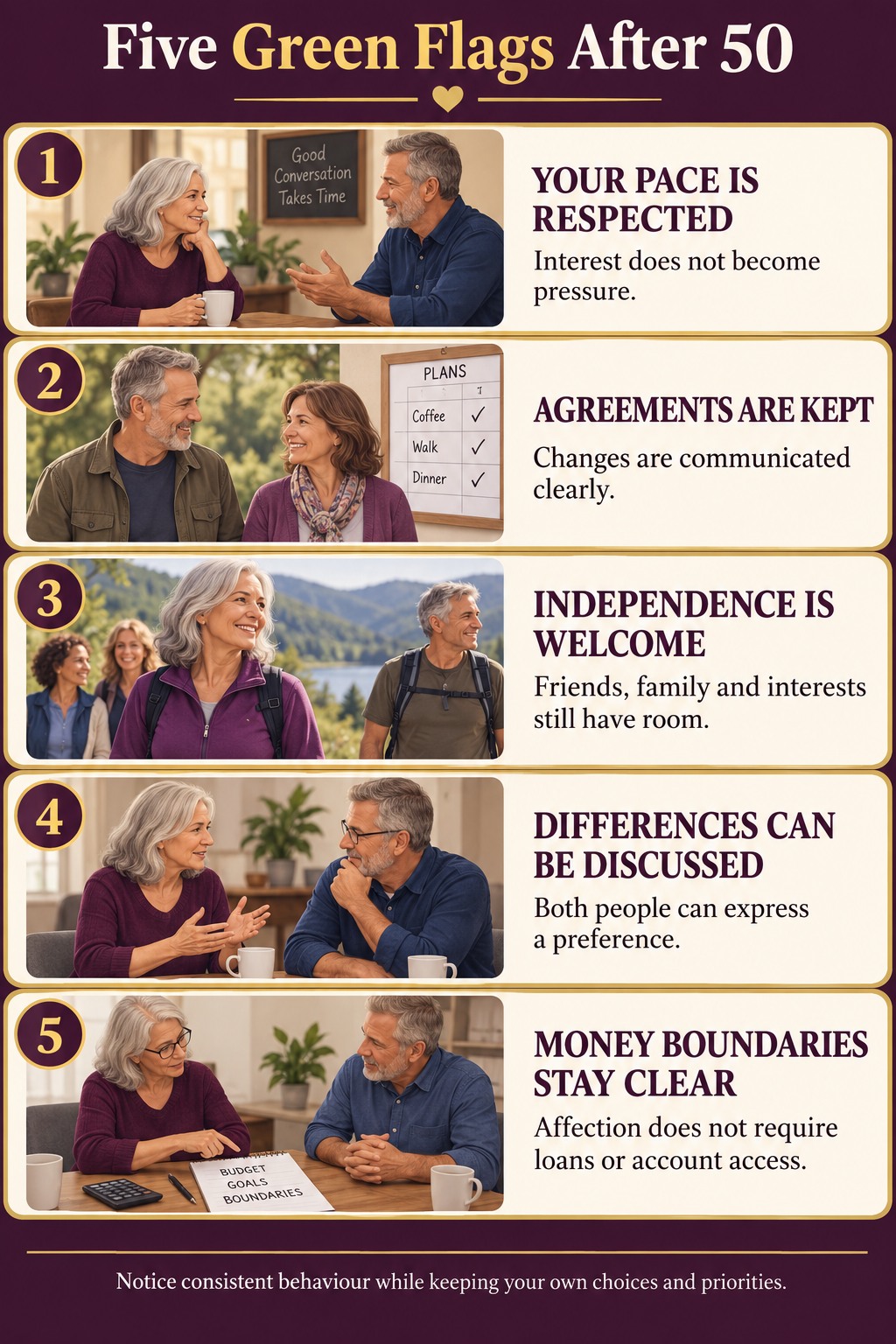
Read the infographic as text
- YOUR PACE IS RESPECTED: Interest does not become pressure.
- AGREEMENTS ARE KEPT: Changes are communicated clearly.
- INDEPENDENCE IS WELCOME: Friends, family and interests still have room.
- DIFFERENCES CAN BE DISCUSSED: Both people can express a preference.
- MONEY BOUNDARIES STAY CLEAR: Affection does not require loans or account access.
2. Their actions match the agreements you actually made
Consistency does not mean constant messaging or never cancelling a plan. It means someone generally does what they agreed to do and communicates when circumstances change. A person who needs to reschedule can explain, apologise where appropriate and suggest another workable time.
Try to distinguish an expectation from an agreement. If you never discussed daily contact, a quiet day does not automatically show disinterest. You can ask what communication feels natural to them and say what works for you.
Repeated broken plans, vague explanations or disappearing after making clear commitments deserve attention. You can decide that a pattern does not suit you without proving a hidden motive.
3. They are interested in your present life
A promising date asks about what you enjoy now, listens to the answer and leaves room for your questions. They do not treat you as a role to fill—a housekeeper, rescuer, financial backer or automatic source of emotional support.
At this stage of life, the practical details can be significant. Perhaps you help an elderly parent, work irregular hours, share time with grandchildren or value living alone. A respectful person is curious about those realities rather than assuming romance should replace them.
You deserve the same opportunity to understand their life. Mutual interest includes hearing about their responsibilities without agreeing to take them on.
4. They make room for independence
A new relationship can become an enjoyable part of your life while you continue seeing friends, pursuing interests and spending time alone. Someone who respects independence does not demand your passwords, expect an immediate reply every time or treat a separate outing as betrayal.
Independence can also concern housing. Two people may want commitment without sharing a home. Others may eventually want to live together. Neither arrangement is automatically more loving; the useful question is whether both people understand and want it.
Keep up the routines that support you while you learn about the connection. A partner who welcomes a full life offers a more encouraging sign than one who asks you to shrink it.
5. They can handle a small disagreement respectfully
You do not need to provoke conflict to assess a person. Ordinary differences will arise: which restaurant to choose, how much to spend on an outing or whether to change a plan. Notice whether they can hear a preference without ridicule, threats or punishment.
A useful response might be, “That isn’t my preference, but we can find another option.” It may also be an honest explanation that the difference matters too much for them. Respectful disagreement leaves both people able to choose.
Watch for repair after a misunderstanding. A specific apology identifies what happened and is followed by an effort to behave differently. You are free to decide whether that effort is enough; forgiveness is not a requirement for continuing a relationship.
6. They are clear about their availability and intentions
Someone does not need to share every detail of a former relationship on a first date. You can still ask whether they are single, separated, in an agreed non-monogamous relationship or otherwise unavailable for what you want. Clear answers help both people decide whether to continue.
Discuss intentions in ordinary language. “I’m open to a committed relationship, but I want to get to know someone first” says more than an impressive promise about destiny. You can ask whether they want companionship, casual dating, exclusivity or a possible long-term partnership.
Intentions can change. An encouraging sign is that changes are communicated rather than concealed while you continue making decisions from an outdated understanding.
7. Money conversations stay clear and free of pressure
You can decide how to pay for dates without revealing account balances or proving generosity. A respectful person can discuss a budget, choose an affordable outing and accept that money decisions belong to you.
Keep financial access separate while you are getting acquainted. Requests for loans, account access, investments, cryptocurrency transfers or emergency funds require more than a romantic story. A person’s age, professional-sounding profile or affectionate messages do not establish that a request is genuine.
The FTC’s romance-scam guidance warns about online relationships that lead to requests for money and advises against sending money or gifts to a love interest you have not met in person. Meeting once also does not make a financial request safe.
If a relationship later involves shared housing, ownership, debt or major gifts, get suitable independent legal or financial advice before making commitments. You can care about someone and take time to understand an agreement.
8. They respect your history without competing with it
You may be divorced, widowed, dating for the first time in years or finding a different kind of relationship than you had before. There is no single emotional schedule everyone must follow.
A considerate person does not demand that you erase photographs, dismiss meaningful memories or prove you have “moved on” by doing something you are not ready for. They can also state their own needs honestly if your availability differs from theirs.
You can share your history gradually. Dating does not create an obligation to disclose painful experiences in detail. Someone who accepts “I’m not ready to discuss that” gives you useful information about how they handle privacy.
9. Practical expectations can be discussed without shame
Enjoyment matters, and so does everyday fit. Retirement plans, travel, caregiving, accessibility, pets, household habits and relationships with adult children can shape what time together looks like.
Talk about one relevant subject at a time. “I help my mother on weekends, so Saturday evenings are often difficult” is more useful than assuming a caring partner will somehow know your schedule. Ask about their constraints too.
Intimacy also deserves a direct, respectful conversation when relevant. Comfort, consent and expectations can be discussed without treating either person as too old to have preferences or too experienced to need a question.
A few everyday examples
| Situation | Encouraging response | Reason to pause |
|---|---|---|
| You prefer a public meeting. | They suggest a café you can reach comfortably. | They repeatedly push to meet privately. |
| You have a prior family commitment. | They look for another time. | They demand you cancel to prove affection. |
| A date is outside your budget. | You agree on an affordable alternative. | They mock your limit or pressure you to spend. |
| You disagree about a plan. | Both preferences are heard. | They insult, threaten or punish disagreement. |
| You want a slower pace. | They respect it or honestly explain a mismatch. | They keep trying to wear down your answer. |
Scroll sideways to see the full table.
These examples are conversation prompts, not a scoring system. A collection of pleasant behaviours does not cancel coercion or a serious boundary violation.
A fictional example: a connection with room to grow
Imagine Elaine, 58, and Martin, 62, who enjoy walking and local theatre. Elaine prefers to keep separate homes and helps care for her sister. Martin would eventually like to share a home, but neither wants to rush.
They talk about the difference rather than promising it will disappear. They agree on dates that fit their schedules and continue discussing what a longer-term relationship might mean. Their willingness to be honest is encouraging, even though they have not settled every question.
If their housing preferences remain incompatible, they can make another choice. A healthy interaction does not have to become a lifelong relationship to have been respectful.
Let patterns inform your next step
After a date, ask a few practical questions: Could I express a preference? Did I feel free to decline? Did their words match what happened? Am I still making time for my own life? You do not need a detailed record of every message.
If you feel unsure, you can slow down, ask a direct question or choose another meeting in a setting you prefer. If someone threatens you or ignores your refusal, prioritise safety and appropriate support. You do not need another date to confirm a pattern before protecting yourself.
For a broader discussion of starting again, see our guide to finding a relationship after 50. If a new connection brings up uncertainty, our guide to intuition and fear in a new relationship can help you separate observations from assumptions.
Dating after 50 does not require abandoning the life you have built. Look for a connection in which warmth, respect and practical honesty appear together—and keep choosing a pace and arrangement that make sense for you.
Frequently asked questions
1. What is a green flag when dating after 50?
It is an encouraging behaviour such as respect, honesty or reliable follow-through. A consistent pattern gives more information than one charming interaction.
2. Does strong chemistry mean we are compatible?
Not by itself. Compatibility also involves your intentions, boundaries, schedules and preferred relationship arrangement.
3. What does respecting my pace look like?
They can state their wishes while accepting your answer. They do not demand intimacy, access or commitment as proof that you care.
4. Does consistency require daily messages?
No. It means keeping the agreements you actually made and communicating changes. Discuss contact preferences instead of assuming a universal rule.
5. Is one cancelled date a red flag?
Not automatically. Consider the explanation, how the change is handled and whether a pattern develops. You can still decide a repeated mismatch does not work for you.
6. Can separate homes fit a committed relationship?
Yes if both people understand and want the arrangement. Sharing a home is not the only way to express commitment.
7. How do I discuss family or caregiving commitments?
Explain the practical effect on your availability and ask about theirs. A new relationship should not require abandoning important responsibilities.
8. What does a respectful disagreement sound like?
Both preferences can be heard without ridicule, threats or punishment. Either person may honestly decide that a difference matters too much to continue.
9. Is an apology enough after a hurtful interaction?
Consider whether it identifies what happened and is followed by changed behaviour. You decide whether repair is sufficient; forgiveness does not require continuing.
10. When should I ask about intentions?
When the answer would affect how you participate. You can ask what they are looking for without demanding a promise about the entire future.
11. Do I have to share painful history on a first date?
No. Share gradually and within your comfort. A respectful person can accept that you are not ready to discuss a subject.
12. How should money come up early on?
Discuss affordable dates and payment preferences without disclosing account balances or granting financial access. Affection should not become spending pressure.
13. Are financial requests safe after meeting once?
A meeting does not establish that a request is safe. Take time, verify independently and get appropriate advice before major financial commitments.
14. Can a person be kind but still unsuitable for me?
Yes. Different housing plans, intentions or priorities can make the arrangement unsuitable without proving anyone has bad motives.
15. What should I notice after a date?
Ask whether you could express a preference, decline freely and keep your normal life. Notice actions over time without turning every message into an investigation.