
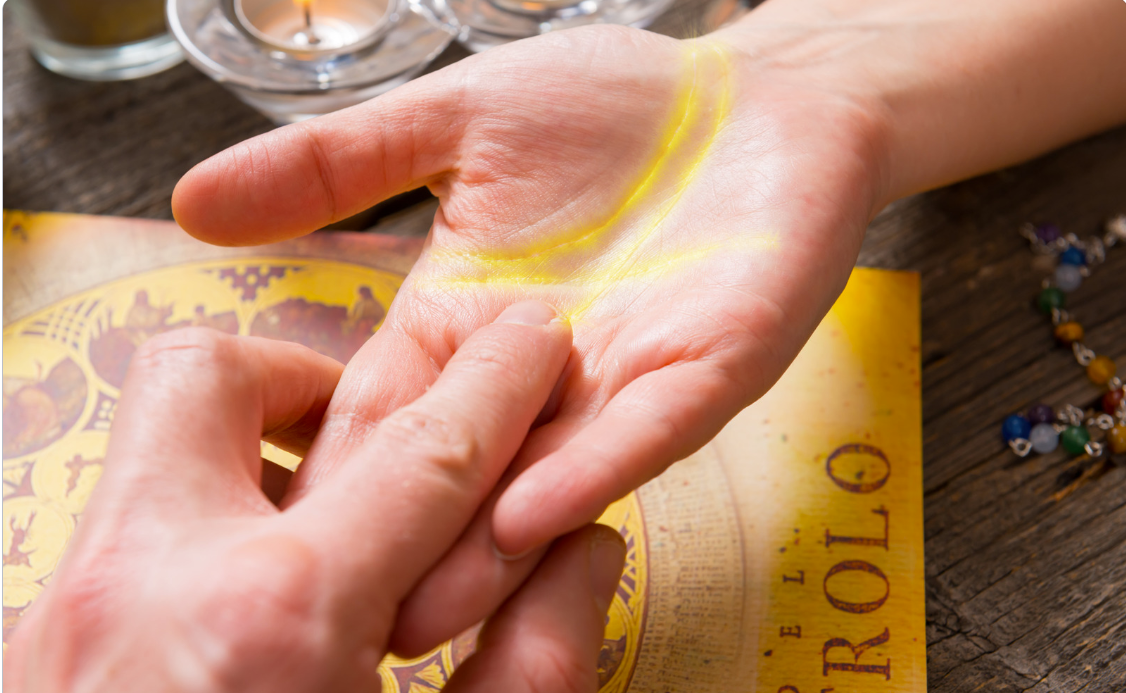
Palm reading, or palmistry, interprets features of the hands as symbols connected with character and life themes. Some readers combine it with astrology. You can explore these ideas as a reflective or entertainment practice without treating palm lines as reliable evidence about personality, health or the future.
A useful reading leaves room for disagreement. It should not turn a crease in your hand into a diagnosis, accusation or fixed destiny.
Palmistry and astrology
Practitioners use different names and methods, including “astro-palmistry” and “Ayurvedic palm reading.” Those labels do not guarantee a single standard or a medically valid assessment. Ask the reader what tradition they follow and what they mean by the term, rather than assuming all methods are interchangeable.
Combining a palm interpretation with a birth chart does not make either interpretation a verified prediction. If a reader offers factual or health advice, evaluate it separately from the symbolism.
Looking at the hand
Use comfortable lighting and let your hand rest naturally. You do not need to force a position or make every faint line stand out. If practising with someone else, ask permission before examining or touching their hand and accept a refusal.
Some readers compare the dominant and non-dominant hands; others follow different conventions. Neither hand establishes someone’s hidden feelings, consent or relationship history. Ask how the reader uses the comparison.
The heart line
Readers commonly call an upper transverse line the “heart line” and associate it with emotional or relationship themes. They may interpret length, curves, forks and breaks differently. These associations are symbolic, not a test of kindness, romantic ability or emotional control.
Instead of saying “this line means you cannot express love,” ask a reflective question: How do I communicate care, and what would I like to improve? Compare the idea with your actual experience.
Forks, faint lines and crossings
A faint line does not prove that someone is easily controlled. Crossings do not identify emotional trauma, and breaks do not reveal a history of short relationships. A fork does not guarantee luck in love.
If a reading raises a relationship concern, this guide to trust and observable relationship behaviour can help you return to communication, accountability and boundaries.
The head line
Palmists often call a middle transverse line the “head line” and connect it with thinking or learning style. A reader might use it to prompt discussion of creativity, planning or decision-making. Its shape does not determine intelligence, impulsiveness, memory or mental health.
Use a prompt such as “When do I make my best decisions?” rather than accepting a permanent label about your mind.
The life line
The line that curves around the base of the thumb is commonly called the “life line.” Despite the name, do not use its length or breaks to estimate lifespan, predict hospitalization or identify childhood illness. Multiple lines do not establish how much someone enjoys life.
A frightening interpretation is not medical evidence. New or concerning symptoms belong with qualified healthcare, not a palm-based diagnosis.
From prediction to reflection
Write down what a reading suggested, what evidence supports it and what does not fit. Broad descriptions can feel personal, so keep contradicting examples as well as apparent matches. This guide to intuition without replacing evidence offers a practical checking approach.
A constructive next step might be practising a communication skill or reviewing a goal. You do not need to buy a remedy to correct a line or remove a supposed curse.
Choosing a reader
- Ask about the total fee and session length beforehand.
- Look for clear uncertainty and permission to disagree.
- Decline guaranteed outcomes, diagnoses or death predictions.
- Keep identifying information and images private unless you choose to share them.
- Stop if the reader uses fear or pressures you into additional purchases.
A simple home exercise
At a home desk, choose one symbolic theme and write a question about it. Answer using real examples from your life. Keep the exercise short and optional. Palmistry can provide a conversation starter, but your actions, circumstances and feedback should guide consequential decisions.
Frequently asked questions
Can palm reading predict my future?
No. Treat a reading as symbolic reflection, not a reliable prediction of events or another person’s choices.
Does a short life line mean a short life?
No. A palm line should not be used to estimate lifespan, illness or the timing of death.
Can palm lines identify trauma or mental illness?
No. Palm reading is not a diagnostic assessment. Use qualified care for health or mental-health concerns.
Which hand should a reader examine?
Methods differ. Ask the reader to explain their convention, and remember that neither hand establishes your personality or relationship history.